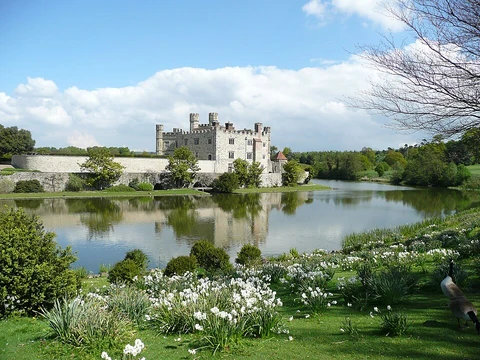
Ballincollig Castle
Norman castle in County Cork, long held by the Barrett family.
Ballincollig Castle, a Norman stronghold built after the invasion of Ireland, sits on a limestone ridge south of the town of Ballincollig in County Cork. At its height, the Barrett family held the castle and dominated the surrounding area. Though now largely a ruin, the site still contains the original keep, much of the curtain wall, and two towers.
A Norman knight named Sir Robert Coll may have raised an earlier castle on the spot, and his name likely gave the town its Irish name, Baile an Choillaigh, or "Town of the Colls." No firm date exists for that first structure, but by 1468 the Barretts had bought Coll’s estate lands at Ballincollig and set about improving and extending the castle. The main buildings we see today date from that period. The bawn and tower house occupy a limestone summit with a clear view over the low-lying Maglin Valley. A natural cavern runs into the rock beneath the castle, and traces of a moat survive around it.
The Barretts traced their roots to Normans who came with William the Conqueror, and some of them joined the Norman invasion of Ireland in 1169. When Henry II divided the spoils, he gave the Kingdom of Cork to Milo de Cogan. The Barretts served as underlords to the de Cogans, fighting in Connacht in 1235 under John de Cogan, and later became tenants of the de Cogans at Carrigrohane. By the 1400s they paid rent to the MacCarthys—£11 a year from 1420—and later to the Earls of Desmond, at 12 marks yearly. In the late 1460s, the Barretts bought Ballincollig Castle outright. A 1611 letter from Sir Dominic Sarsfield to Lord Carew records that the purchase happened in the eighth year of Edward IV’s reign (1468–69) from a knight named Robert Coil, and notes a deed of entail in Sarsfield’s own lands.
The castle became the main Barrett stronghold until the early 1600s, when the Castlemore Barretts controlled Mourne Abbey, Garrycloyne, Castleinch, Ballincollig, and Cloghan McUllick, and also held Carrigrohane for a time. In the 1590s a violent dispute erupted. In July 1591, Andrew Barrett and sixty others stormed the castle with swords, guns, sledges, hammers, skenes, stones, and staves, throwing out Edmund Barrett. Three years later, Edmund won a decree for £100 against the Sheriff of County Cork for refusing to enforce a writ to evict Andrew and his followers. In 1595, Edmund took his cousin to court; Andrew was fined £20, two ot
- location
- Ballincollig, County Cork, Ireland
- type
- Norman castle with tower house and bawn
- built
- 13th century (keep); 15th century (bawn and towers)
- original owner
- Sir Robert Coll (possibly)
- notable inhabitants
- Barrett family
- current status
- Privately owned, largely ruined
Lore & Background
An earlier castle may have been built on the site by Sir Robert Coll, a Norman knight, whose name likely influenced the name of Ballincollig. By 1468, the Barrett family purchased Coll's estate lands and improved and extended the castle, constructing the main structures. The bawn and tower house sit on a limestone summit with a line of sight over the Maglin Valley, and beneath the castle is a natural cavern with remains of a moat around it.
The Barretts, who had traveled from Normandy with William the Conqueror and later to Ireland in 1169, became underlords of the de Cogans and later the MacCarthys and Earls of Desmond. In the late 1460s, they purchased Ballincollig Castle outright, as recorded in the Carew Calendar of 1611. The castle became their principal stronghold until the early 17th century. During the 1590s, a dispute arose: in July 1591, Andrew Barrett and sixty others assaulted the castle and dispossessed Edmund Barrett, leading to court actions and fines.
By the early 17th century, the Barretts lost the castle due to debt, mortgaging it in 1618 to the Coppingers of Cork. By 1630, Sir Walter Coppinger came into full possession. The castle was taken by Oliver Cromwell's forces by 1644, garrisoned for James II around 1689, and fell into disuse after 1690. The keep was repaired by the Wyse family in 1857, and the castle remains in private ownership today.
Reader's Guide
Ballincollig Castle is significant as a well-preserved example of a Norman fortified residence in County Cork, illustrating the feudal and colonial history of Ireland after the Norman invasion. Its architecture—a 13th-century keep with a 15th-century bawn and towers—reflects the evolution of defensive and domestic structures over centuries. The castle's history encapsulates the rise and fall of the Barrett family, who held it as their principal stronghold for over a century before losing it to financial pressures and changing political tides. The site's inclusion in the Archaeological Survey of Ireland's Sites and Monuments Record underscores its archaeological importance. Today, though in private hands and largely ruined, the castle remains a tangible link to medieval Irish history, with its surviving keep, curtain wall, and towers offering insight into Norman building techniques and the social dynamics of land ownership and conflict in the region.
Did You Know?
- The castle's keep is 45 to 50 feet high and originally had no ground-floor entrance except by a trap door from above.
- In July 1591, Andrew Barrett and sixty others assaulted Ballincollig Castle with swords, guns, sledges, and stones to dispossess Edmund Barrett.
- The Barretts purchased the castle outright in 1468–69 from Sir Robert Coll, as recorded in a deed from the 8th year of Edward IV.
- A natural cavern runs into the rock beneath the castle, and around it are the remains of a moat.
More in Norman castles 1-24
Spotted an error? Know more?
This is a living reference — every entry is fact-audited, and reader corrections feed straight into our audit queue. Suggest an edit · See this site's audit record