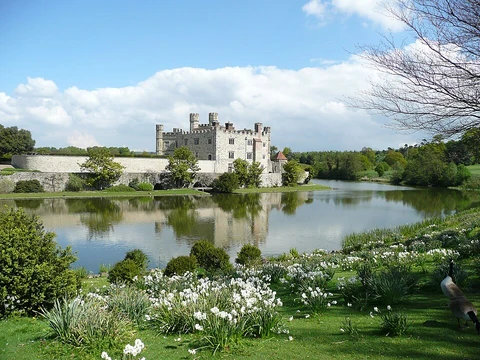
Colchester Castle
Largest Norman keep in Europe, built on Roman temple foundations.
Colchester Castle, a Norman fortress in Colchester, Essex, was built in the latter half of the eleventh century. It sits within Castle Park, which takes its name from the structure. The keep, largely intact, is the largest surviving Norman keep in England, a result of being constructed atop the foundations of the Roman Temple of Claudius. The castle withstood a three-month siege in 1216, but by the 1600s it had decayed; its curtain walls and parts of the keep’s upper levels were torn down, and its original height remains uncertain. What remained was used as a prison and later partly restored as a large garden pavilion. Colchester Borough Council bought it in 1922. Since 1860, the castle has housed Colchester Museum, featuring a significant collection of Roman artifacts. It is both a scheduled monument and a Grade I listed building.
Construction began after the Norman Conquest, when stone keeps were built to project Norman authority over the Anglo-Saxons. Along with the White Tower in London, Colchester is among England’s earliest stone towers. A charter from Henry I in 1101, granting the town and castle to Eudo Dapifer, suggests it was a royal foundation. The late-13th-century Colchester Chronicle, though unreliable, credits Eudo with building the castle and gives a start date of 1076. The design is linked to Gundulf of Rochester only because of similarities to the White Tower, though both resemble the earlier Château d’Ivry-la-Bataille in Normandy.
The keep’s ground plan, at 152 by 112 feet, is one and a half times the size of the White Tower’s, making it the largest medieval tower in Britain or Europe. This enormous size came from using the podium of the Temple of Claudius, built between AD 49 and 60—the largest Roman temple in Britain. The site, on high ground at the western end of the walled town, already held a Saxon chapel and possibly a royal vill near the temple ruins. Reusing the site provided ready-made foundations and Roman building materials in a region lacking natural stone. The Normans also saw themselves as imperial successors to the Romans, with William compared to Julius Caesar. The Colchester Chronicle called the temple site a palace of the mythical King Coel, giving the Normans a heroic lineage. Placing the castle so close to the town center broke the usual pattern of Norman castles being built on the town’s outskirts.
Site preparation
- location
- Colchester, Essex, England
- type
- Norman castle keep
- construction_start
- c. 1076 (according to the late-13th-century Colchester Chronicle, though this source is considered unreliable)
- keep_dimensions
- 152 by 112 feet (46 m × 34 m)
- current_use
- Museum (since 1860)
- designation
- Scheduled monument and Grade I listed building
Lore & Background
Colchester Castle was one of a generation of stone keeps built by the Normans in the aftermath of the Norman Conquest of England, as part of the Normans' effort to impress their authority upon the conquered Anglo-Saxons. Alongside the White Tower in London, Colchester is one of the earliest stone towers in England. The attribution of the castle as a royal foundation is based on a charter of Henry I dated 1101, granting the town and castle of Colchester to Eudo Dapifer 'as my father had them and my brother and myself', Henry's father and brother being William I, 'William the Conqueror', and William II, 'William Rufus'. The somewhat unreliable Colchester Chronicle, written in the late 13th century, credits Eudo with the construction of the castle and gives a commencement date of 1076. The design of the castle has been associated with Gundulf of Rochester purely on the basis of the similarities between Colchester and the White Tower at the Tower of London; however, both keeps also resemble the much earlier example at Château d'Ivry-la-Bataille in Upper Normandy.
Reader's Guide
Colchester Castle's significance lies in its immense keep, the largest of any medieval tower in Europe, a size dictated by its construction atop the podium of the Roman Temple of Claudius, the largest Roman temple in Britain. This reuse of Roman foundations and materials, in an area without naturally occurring stone, also reflects the Normans' desire to present themselves as imperial successors to the Romans. The castle's history includes a three-month siege in 1216, later disrepair leading to partial demolition in the 17th century, and subsequent use as a prison and garden pavilion before being purchased by the borough council in 1922. Since 1860, it has housed Colchester Museum, with an important collection of Roman exhibits. The original height of the keep remains debated, with theories ranging from two to four storeys, and the position of the original entrance is also uncertain. As a scheduled monument and Grade I listed building, it stands as a key example of Norman military architecture and a direct link to Roman Britain.
Did You Know?
- The keep of Colchester Castle is the largest example of its kind anywhere in Europe.
- It was built on the foundations of the Roman Temple of Claudius, the largest Roman temple in Britain.
- The castle endured a three-month siege in 1216.
- The original height of the keep is debated, with theories of two, three, or four storeys.
More in Norman castles 1-24
Spotted an error? Know more?
This is a living reference — every entry is fact-audited, and reader corrections feed straight into our audit queue. Suggest an edit · See this site's audit record