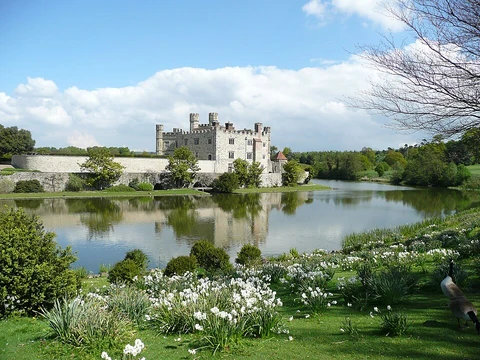
Drimnagh Castle
Norman castle with Ireland's only flooded moat.
Drimnagh Castle is a Norman castle located in Drimnagh, a suburb of Dublin, Ireland. It is notable as the only remaining castle in Ireland with a flooded moat, fed by a tributary of the River Camac. The castle's history spans from the 13th century to the present day, serving as a fortification, a family home, a school, and a public heritage site.
- location
- Drimnagh, Dublin, Ireland
- type
- Norman castle
- earliest_recorded_owner
- Sir Hugh de Bernival (1216)
- notable_feature
- Only remaining castle in Ireland with a flooded moat
- current_status
- Open to the public for tours and events as of 2019
Lore & Background
The earliest recorded owner of Drimnagh Castle was Sir Hugh de Bernival, whose name appears in state papers from 1216. His family, later known as Barnewell or Barnewall, built a fortification here in the mid-13th century, though the main surviving structures date to the early 15th century. These include a great hall and an attached tower from the 16th or 17th century, as well as a large early-20th-century stone building used as a stable, ballroom, and coach house.
By the mid-19th century, the castle was owned by the Marquess of Lansdowne, with Samuel Lewis's Topographical Dictionary of Ireland (1837) describing it as an 'irregular pile' occupied by Mr. E. Cavanagh. In the early 1900s, dairy man Joseph Hatch bought the castle for grazing land, restored it, and used it as a summer home. After his death in 1918, his son Louis Hatch inherited it; Louis died in 1951, and the castle was left to Dr. P. Dunne, who sold it to the Christian Brothers for a school.
In the mid-1980s the castle was a ruin. A restoration programme led by Peter Pearson and An Taisce, with help from FÁS, rebuilt the great hall's medieval oak roof and created a formal medieval-style garden. The castle reopened to the public in 1991 and as of 2019 offers tours, wedding venues, and dry stone walling courses.
Reader's Guide
Drimnagh Castle holds significance as a rare surviving example of a Norman castle with a flooded moat, a feature unique in Ireland. Its continuous occupation and adaptation over eight centuries—from medieval fortification to dairy farm, school, and public heritage site—illustrate the evolving use of historic structures. The restoration in the late 20th century, carried out by hand using traditional methods, preserved the castle's medieval character while making it accessible to the public. The castle's legacy also includes its role as a film location for productions such as The Abduction Club, Ella Enchanted, and The Tudors, and its connection to the local community through the GAA club that renovated its coach-house. Today, it serves as both a tourist attraction and a venue for events, ensuring its continued relevance.
Did You Know?
- Drimnagh Castle is the only remaining castle in Ireland with a flooded moat.
- The castle's moat is fed by a tributary of the River Camac.
- The castle was used as a film location for The Tudors (2007) and Ella Enchanted (2004).
- In the mid-1980s, the castle was a ruin with fallen roofs and missing windows before a restoration programme began.
More in Norman castles 1-24
Spotted an error? Know more?
This is a living reference — every entry is fact-audited, and reader corrections feed straight into our audit queue. Suggest an edit · See this site's audit record