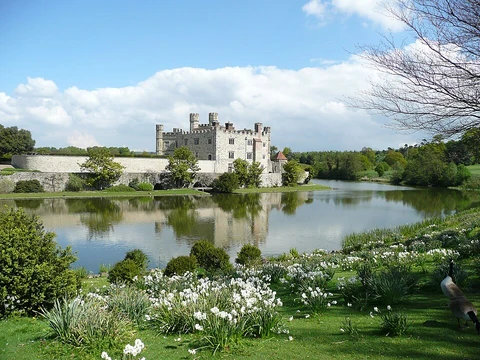
Dublin Castle
Historic seat of British rule in Ireland, now a state complex.
Dublin Castle is a major Irish government complex, conference centre, and tourist attraction located off Dame Street in central Dublin. Originally a stone castle with a courtyard design, it was mostly rebuilt from the late 17th century onward as a Georgian palace. A castle has stood on the site since the days of King John, the first Lord of Ireland, and it served as the seat of English, then later British, government of Ireland under the Lordship of Ireland, the Kingdom of Ireland, and the United Kingdom of Great Britain and Ireland until 1922.
- Location
- Off Dame Street, central Dublin, Ireland
- Founded
- 1204 by order of King John of England
- Original Purpose
- Defensive fortification for the Norman city of Dublin
- Historical Role
- Seat of English and British government in Ireland until 1922
- Current Use
- Government complex, conference centre, tourist attraction, and site of presidential inaugurations
- Notable Feature
- Record Tower, sole surviving tower of the original medieval fortification
Lore & Background
Dublin Castle was first founded as a major defensive work by order of King John of England in 1204, sometime after the Norman invasion of Ireland in 1169. Largely complete by 1230, it was of typical Norman courtyard design with a central square without a keep, bounded by tall defensive walls and protected at each corner by a circular tower. The castle was built by the dark pool (Dubh Linn in Irish) which gave Dublin its name, and was sited to the southeast of Norman Dublin, using the River Poddle as a natural defence along two of its sides.
Reader's Guide
Dublin Castle's significance lies in its long role as the administrative centre of English and British rule in Ireland from the 13th century until 1922. After the signing of the Anglo-Irish Treaty in December 1921, the complex was ceremonially handed over to the newly formed Provisional Government led by Michael Collins. It now hosts the inauguration of each President of Ireland and various state receptions, including the historic visit of Queen Elizabeth II in 2011. The castle also temporarily assumed the role of the Four Courts after the Civil War and now houses conference facilities, museums, and government offices. Its evolution from a medieval fortress to a Georgian palace and modern state complex reflects the broader political and social changes in Ireland over centuries.
Did You Know?
- In January 1592, Red Hugh O'Donnell and brothers Art and Henry O'Neill escaped from the castle after a period of imprisonment; Art died of exposure during the escape.
- The Irish Crown Jewels were stolen from the castle in 1907 and have never been recovered.
- During the Easter Rising of 1916, a small force of Irish Citizen Army members seized the entrance and guard room of the castle but were quickly repelled.
- The castle's Record Tower (c. 1228–1230) is the sole surviving tower of the original medieval fortification.
More in Norman castles 1-24
Spotted an error? Know more?
This is a living reference — every entry is fact-audited, and reader corrections feed straight into our audit queue. Suggest an edit · See this site's audit record