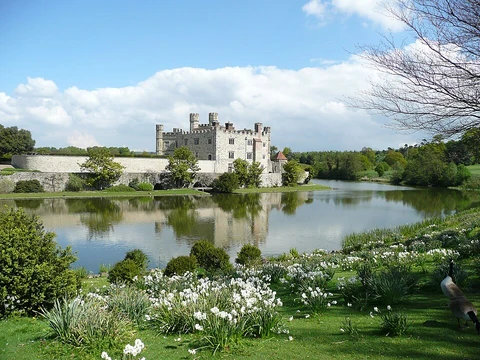
Dunlough Castle
One of Ireland's oldest castles, built by Donagh O’Mahony in 1207.
Dunlough Castle, founded in 1207 by Donagh O’Mahony, is one of the oldest castles in Ireland. It stands atop cliffs at the northern tip of the Mizen Peninsula, the extreme southwest point of Ireland, overlooking the Atlantic Ocean. The castle is a notable example of native Irish dry stone masonry.
- architectural_style
- Native Irish dry stone masonry
Lore & Background
Dunlough Castle was founded in 1207 by Donagh O’Mahony, chieftain of the O'Mahony clan, who had been driven westward by Norman expansion. The castle consists of three fortified towers, or keeps, connected by a wall that stretches from the western cliffs to the shore of an apparently man-made lake. The only access is from the south across private farmland, and a small footpath between the western ruins and the cliffs allows entry to the towers. The castle was designed to appear impregnable, with cliffs, a defensive wall, and a lake blocking approach, though it is not known if it was ever attacked.
Reader's Guide
Dunlough Castle is significant as one of the oldest castles in Ireland and a rare example of dry stone masonry in a Norman-style fortification. Its three distinct keeps, each with different stair designs, illustrate early Irish castle architecture. The castle was held by the O'Mahony family for 400 years until confiscated by the British crown in 1627. Its remote location and defensive features highlight the strategic challenges faced by invading forces in medieval Ireland. The castle's deterioration is partly due to its dry stone construction, which was common in earlier Irish buildings but unusual for later castles in the region.
Did You Know?
- Dunlough Castle is one of the oldest castles in Ireland, founded in 1207.
- The castle features three towers connected by a wall spanning over 100 feet.
- It is not known if Dunlough was ever attacked.
- The O'Mahony family held the castle for 400 years until their lands were confiscated during the Cromwellian conquest in the 1650s.
More in Norman castles 1-24
Spotted an error? Know more?
This is a living reference — every entry is fact-audited, and reader corrections feed straight into our audit queue. Suggest an edit · See this site's audit record