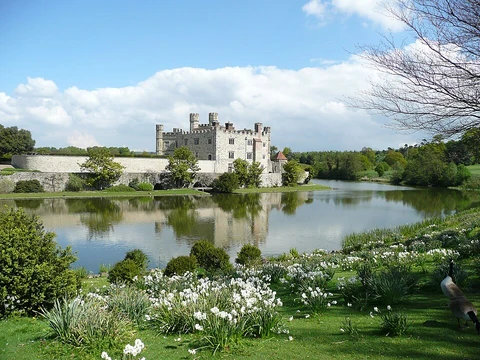
Durham Castle
Norman castle, bishop's seat, now a university college.
Durham Castle is a Norman castle in the city of Durham, England. It has been occupied since 1837 by University College, Durham, after its previous role as the residence of the Bishops of Durham. Designated since 1986 as a cultural World Heritage Site in England, along with Durham Cathedral, the castle is open to the general public to visit, but only through guided tours, since it is in use as a working building and is home to over 100 students.
- builder
- Ordered by William the Conqueror, built under Waltheof and Bishop Walcher
Lore & Background
Construction of the castle, of the motte and bailey design favoured by the Normans, began in 1072 under the orders of William the Conqueror, six years after the Norman Conquest of England. The construction took place under the supervision of Waltheof, Earl of Northumbria, until he rebelled against William and was executed in 1076. Stone for the new buildings was cut from the cliffs below the walls and moved up using winches. The holder of the office of the bishop of Durham, Bishop Walcher at the time, was appointed by the king to exercise royal authority on his behalf, with the castle being his seat. Walcher continued the building of the castle, as a combination of bishops' palace and defensive stronghold. In May 1080, the castle was attacked and besieged for four days by rebels from Northumbria and Bishop Walcher was killed.
In the 12th century, Bishop Pudsey built the Norman archway and the Galilee of the cathedral. In 1177, King Henry II of England seized the castle after a disagreement with de Puiset. Other major alterations were made by Bishop Thomas Hatfield in the 1300s, including a rebuilding of the keep and enlargement of the keep mount. The castle has a large Great Hall, originally called a Dining Hall, created by Bishop Antony Bek in the early 14th century; a wooden minstrels' gallery was added later, possibly in the 15th or 16th century. The hall was modified and enlarged, then reduced, in size by subsequent bishops. Today, the Hall is 14 metres high and over 30 metres long.
The castle remained the bishop's palace for the Bishop of Durham until Auckland Castle was made the bishops' residence in 1832. Subsequently, Durham castle was donated to the University of Durham by Bishop William Van Mildert and would later become the college. The college did not occupy the castle until 1837, after the next Bishop, Edward Maltby, had completed renovations of the building.
Reader's Guide
Durham Castle is significant as a well-preserved Norman motte and bailey fortress that served as the seat of the prince-bishops of Durham for centuries. These prince-bishops were granted wide remit by the English crown, allowing them virtual autonomy to raise an army, levy taxes, and mint their own coinage, acting as a defence against Scottish incursions and internal rebellions. The castle's continuous use—first as a bishop's palace, then as a university college since 1837—makes it a rare example of a living historic building. Its joint UNESCO World Heritage designation with Durham Cathedral underscores its architectural and historical importance. Seventeen elements of the castle are listed at Grade I, including the keep, the north and west ranges, the entrance gatehouse, a bastion, and twelve sections of the castle walls. The Norman Chapel, the oldest accessible part of the castle, has served various roles over centuries, including as a command post during the Second World War and later as a bike shed, before being re-consecrated in the 1950s. The castle remains open to the public through guided tours, balancing its role as a home for over 100 students with its heritage mission.
Did You Know?
- The castle was attacked and besieged for four days in May 1080 by rebels from Northumbria, during which Bishop Walcher was killed.
- During the Second World War, the Norman Chapel was used as a command and observation post for the Royal Air Force, and later as a bike shed.
- The Great Hall is 14 metres high and over 30 metres long, originally created by Bishop Antony Bek in the early 14th century.
- The castle was donated to the University of Durham by Bishop William Van Mildert and was first occupied by the college in 1837.
More in Norman castles 1-24
Spotted an error? Know more?
This is a living reference — every entry is fact-audited, and reader corrections feed straight into our audit queue. Suggest an edit · See this site's audit record