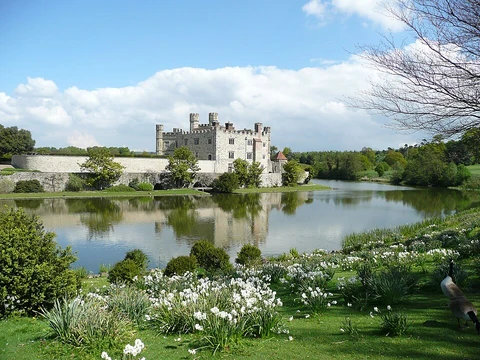
Kidwelly Castle
Ruined Norman castle in Wales, site of medieval sieges and legend.
Kidwelly Castle is a ruined castle in Carmarthenshire, Wales, overlooking the River Gwendraeth and the town of Kidwelly. Built soon after the Norman conquest of the area in 1106, it served as a military, economic, and spiritual center of Norman rule in south Wales, and was repeatedly contested between Welsh and English forces over the centuries.
- notable_events
- Siege and beheading of Gwenllian ferch Gruffudd (1136); captured by Rhys ap Gruffudd (1158); besieged during Glyndŵr Rising (1403–1404)
Lore & Background
Kidwelly Castle was established around 1106 by Roger, bishop of Salisbury, after the Norman conquest of the cantref of Kidwelly. The original structure was an earth and timber ringwork, of which the semicircular outer ditch remains. The castle changed hands multiple times in the 12th century: in 1136, Welsh princess Gwenllian ferch Gruffudd was beheaded after being captured in a battle near the castle, and in 1158 Rhys ap Gruffudd took the castle, later recognized by King Henry II as ruler of the region. The castle was captured and possibly damaged by Llywelyn the Great in 1215 and again in 1231, but was back in English hands by 1244.
The present stone castle was likely begun in the 1270s by Payn de Chaworth, Edward I's commander in south Wales, who built the square inner ward with large round corner towers. A royal loan of £360 in 1277 indicates Edward I's strategic interest. Construction of the outer ward occupied much of the 14th century, and the gatehouse was still incomplete at the time of the Glyndŵr Rising. The castle was unsuccessfully besieged in August 1403 by Welsh forces led by Henry Dwnn, with French and Breton assistance, and attacked again in 1404. The gatehouse was finally completed in 1422.
After Henry VII's accession in 1485, the castle was granted to Rhys ap Thomas, who modernized the accommodation with a new great hall. It reverted to the Crown in 1531, gradually fell into ruin, and was taken into state care in 1927. The castle is now managed by Cadw.
Reader's Guide
Kidwelly Castle is significant as a well-preserved example of a concentric medieval fortress in south Wales, reflecting the turbulent history of Anglo-Welsh conflict. Its construction phases—from the early Norman ringwork to the 13th-century stone inner ward and 14th-century outer ward—illustrate evolving military architecture. The castle's design, with a square inner bailey defended by four round towers and a semi-circular outer curtain wall, follows concentric principles, though the river prevents full encirclement. The great gatehouse, begun in 1388–89 by John of Gaunt, resembles those of major north Welsh castles like Harlech. The castle's role in Edward I's campaign against Llywelyn ap Gruffudd and its involvement in the Glyndŵr Rising highlight its strategic importance. Its legacy includes its use as a film location for Monty Python and the Holy Grail (1975) and the Robin of Sherwood episode 'Herne's Son' (1986), as well as local folklore of the headless ghost of Gwenllian ferch Gruffudd. Today, as a Cadw property, it offers insight into medieval lordship, warfare, and the contested history of the Welsh Marches.
Did You Know?
- The castle was used as a location for the 1975 film Monty Python and the Holy Grail, appearing in the first scene after the titles.
- The surrounding countryside is reputedly haunted by the headless ghost of Gwenllian ferch Gruffudd, who was beheaded in 1136.
- The great gatehouse was begun in 1388–89, possibly under the patronage of John of Gaunt, duke of Lancaster, and was still incomplete at the time of the Glyndŵr Rising.
- A royal loan of £360 in 1277 suggests Edward I regarded the castle as important for his campaign against Llywelyn ap Gruffudd.
More in Norman castles 1-24
Spotted an error? Know more?
This is a living reference — every entry is fact-audited, and reader corrections feed straight into our audit queue. Suggest an edit · See this site's audit record