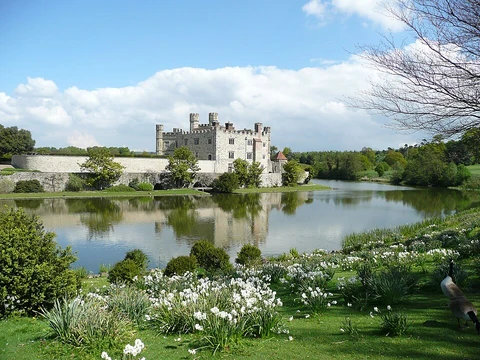
Lea Castle
Ruined medieval castle of the FitzGeralds, site of sieges and imprisonment.
Lea Castle is a ruined medieval castle located near Portarlington, County Laois, on the south bank of the River Barrow. Its remains mostly date to the 13th century and consist of a four-storey donjon and a gatehouse. The castle was the property of the FitzGerald family, who held the title Earl of Kildare from 1316, and was the site of notable conflicts in medieval Ireland.
- notable event
- Richard de Burgh, 2nd Earl of Ulster, was not imprisoned here; he was held at Maynooth Castle or another Fitzgerald castle in Kildare in 1294–5.
Lore & Background
A timber castle was built in the late 12th or early 13th century and later replaced by a stone castle. The FitzGeralds clashed fiercely with Richard de Burgh, 2nd Earl of Ulster, in the 1290s, but contrary to earlier claims, de Burgh was not held prisoner at Lea Castle in 1294–5; he was imprisoned at Maynooth Castle or another Fitzgerald stronghold in Kildare. The castle was besieged in 1307. The O'Dempseys captured it in February 1330, and the recapture was carried out by the justiciar or local forces, not by Maurice FitzGerald, 1st Earl of Desmond. Following the death of justiciar Ralph de Ufford in 1346, claims that Lea was destroyed by the O'More, O'Connor Faly, and O'Dempsey families are unsubstantiated; reliable sources do not record such destruction that year. It was again captured in 1452. In 1650 the donjon was partly blown up and left as a ruin.
Reader's Guide
Lea Castle's significance lies in its role as a stronghold of the FitzGerald family during a turbulent period in medieval Ireland. Its history of imprisonment, sieges, and destruction reflects the power struggles among Anglo-Norman lords and Gaelic families. The castle's layout, with a four-storey donjon and twin-towered gatehouse, illustrates typical 13th-century fortification. Archaeologist Karen Dempsey has suggested that the main entrance may have been at second floor level, possibly accessed by a wooden bridge, challenging traditional interpretations. The castle's ruinous state after 1650 marks the end of its active use, but its remains provide valuable insight into medieval castle design and the political conflicts of the era.
Did You Know?
- Richard de Burgh, 2nd Earl of Ulster, was not held prisoner in Lea Castle in 1294–5; he was imprisoned at Maynooth Castle or another Fitzgerald castle in Kildare.
- The donjon was partly blown up in 1650 and left as a ruin.
- Archaeologist Karen Dempsey suggests the main entrance may have been at second floor level, possibly accessed by a wooden bridge.
- The second floor contained a chapel in the north tower.
More in Norman castles 1-24
Spotted an error? Know more?
This is a living reference — every entry is fact-audited, and reader corrections feed straight into our audit queue. Suggest an edit · See this site's audit record