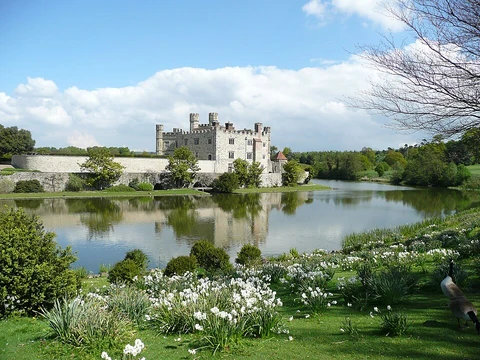
Tamworth Castle
Norman castle on a Mercian royal site, well-preserved motte-and-bailey.
Tamworth Castle is a Grade I listed Norman castle in Tamworth, Staffordshire, England, overlooking the confluence of the River Anker and the River Tame. Before boundary changes in 1889, the castle was within Warwickshire while most of the town belonged to Staffordshire. The site served as a residence of Mercian kings in Anglo-Saxon times, fell into disuse during Viking invasions, and was refortified by the Normans. It is today one of the best-preserved motte-and-bailey castles in England.
- Location
- Tamworth, Staffordshire, England
- Type
- Motte-and-bailey castle with shell keep
- Construction started
- 1080s (wooden castle by Robert Despenser)
- Notable owners
- Marmion family (c.1100–1294), Freville family (1294–1423), Ferrers family
- Current owner
- Tamworth Borough Council (since 1897)
- Listed status
- Grade I listed building
Lore & Background
Tamworth became the chief residence of Offa, ruler of the Mercian kingdom, who built a palace there from which charters were issued, the first dating from 781. Little survived the Viking attack of 874 that left the town 'for nearly forty years a mass of blackened ruins'. In 913 Æthelflæd, Lady of the Mercians, rebuilt Tamworth with an earthen burh, but it was sacked again by Danes in 943. After the Norman Conquest, William the Conqueror granted the place to his steward Robert Despenser, who built a wooden castle in the 1080s. The Marmion family, hereditary champions of the Dukes of Normandy and then of English kings, held the castle for six generations from c.1100 to 1294, during which time it began to be remodelled in stone. In 1215 Robert Marmion, 3rd Baron Marmion of Tamworth, deserted King John, leading to an order for the castle's demolition; archaeologist Tom McNeill says it is unclear whether the order was followed. The castle later passed through the Freville and Ferrers families, with additions in the Jacobean period. During the English Civil War, it was captured by Parliamentary forces after a two-day siege in 1643 and garrisoned, thus escaping slighting. In 1897 Tamworth Corporation purchased the castle for £3,000 to mark Queen Victoria's diamond jubilee, and it opened as a museum in 1899.
Reader's Guide
Tamworth Castle is significant as a rare example of a motte-and-bailey castle that evolved continuously from the Norman period through the Jacobean era, retaining its defensive structure while being adapted as a residence. Its history reflects key phases of English medieval and early modern history: the Mercian royal palace of Offa, the Viking and Danish attacks, Norman refortification, the Marmion family's role as hereditary champions, and the castle's survival of the English Civil War. The site's archaeological value is underscored by excavations in 1972 and 1974. The castle's purchase by the town council in 1897 for the diamond jubilee and its opening as a museum in 1899 mark an early example of municipal heritage preservation. Its Grade I listing and status as one of the best-preserved motte-and-bailey castles in England underscore its architectural and historical importance.
Did You Know?
- Before 1889 boundary changes, Tamworth Castle was within Warwickshire while most of the town belonged to Staffordshire.
- The castle was ordered to be demolished in 1215 after Robert Marmion deserted King John, but it is unclear if the order was carried out.
- During the English Civil War, the castle was captured by Parliamentary forces after only a two-day siege in 1643 and was garrisoned, escaping slighting.
- The castle was purchased by Tamworth Corporation in 1897 for £3,000 to mark Queen Victoria's diamond jubilee and opened as a museum in 1899.
More in Norman castles 1-24
Spotted an error? Know more?
This is a living reference — every entry is fact-audited, and reader corrections feed straight into our audit queue. Suggest an edit · See this site's audit record