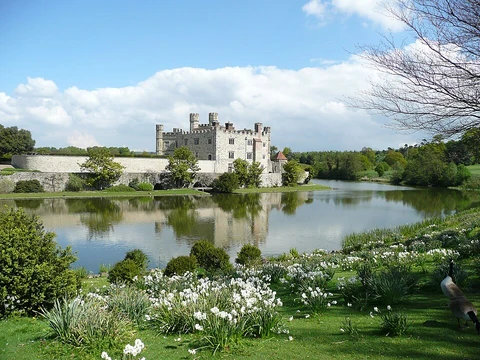
Wallingford Castle
A powerful royal castle, never taken in siege during the Anarchy.
Wallingford Castle is a medieval castle in Oxfordshire (historically Berkshire), England, established in the 11th century as a motte-and-bailey design within an Anglo-Saxon burgh. It grew to become what historian Nicholas Brooks described as 'one of the most powerful royal castles of the 12th and 13th centuries', held for the Empress Matilda during the Anarchy and never taken by siege. After centuries as a luxurious royal residence, it was slighted during the English Civil War, and its limited remains and earthworks are now open to the public.
- location
- Wallingford, Oxfordshire (historically Berkshire), England
- established
- 11th century (between 1067 and 1071)
- builder
- Robert D'Oyly
- notable_holder
- Brien FitzCount
- key_event
- Treaty of Wallingford (1153)
- current_status
- Ruins and earthworks open to the public
Lore & Background
Wallingford Castle was probably built by Robert D'Oyly between 1067 and 1071, on the site of high-status Anglo-Saxon housing. It was constructed in the north-east corner of the town, using the old Anglo-Saxon ramparts, with a motte 60 metres across and 13 metres high. Robert endowed a college of sixteen priests within the castle, named St Nicholas College. The castle passed to Brien FitzCount, who strengthened it in stone in the 1130s, creating a shell keep and curtain wall that made it one of the most powerful royal castles of its time. During the Anarchy, Brien held the castle for Empress Matilda, and it survived multiple sieges by King Stephen, including a prolonged blockade in 1152–1153. The castle's garrison ran low on food, but Henry, the Empress's son, relieved it, leading to the Treaty of Wallingford and eventually the end of the civil war. Brien then entered a monastery and surrendered the castle to Henry in 1153.
Reader's Guide
Wallingford Castle's significance lies in its role as a key royal fortress during the 12th and 13th centuries, particularly during the Anarchy, where it was held for Empress Matilda and never captured. Its survival of multiple sieges and its part in the Treaty of Wallingford, which helped end the civil war, mark it as a pivotal site in English medieval history. Later, it became a luxurious residence for royalty and the Earls of Cornwall, and was used as a prison. After being abandoned by Henry VIII, it was refortified in the English Civil War and eventually slighted by Parliamentary forces. The site's limited remains and earthworks, now open to the public, offer a tangible link to this turbulent past. Its history illustrates the evolution of castle design, from motte-and-bailey to stone fortification, and the political and military importance of such strongholds in controlling the Thames Valley.
Did You Know?
- The castle was built on top of high-status Anglo-Saxon housing, probably belonging to former housecarls.
- Brien FitzCount established a notorious prison called Cloere Brien, where the nobleman William Martel was held.
- The Treaty of Wallingford, negotiated outside the castle in 1153, led to the end of the Anarchy.
- The motte today is 60 metres across and 13 metres high.
More in Norman castles 1-24
Spotted an error? Know more?
This is a living reference — every entry is fact-audited, and reader corrections feed straight into our audit queue. Suggest an edit · See this site's audit record